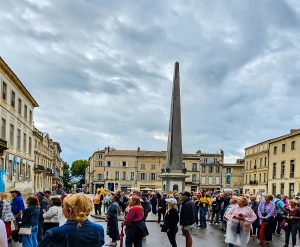
Once provincial capital of ancient Rome … listed UNESCO World Heritage Sites … famed for inspiring Van Gogh’s contemporary paintings … unique ancient Roman three-tiered arch aqueduct built in first century AD …

Where is it
Situated on Rhone River, Provence region, Southern France, city of Arles, famed for imposing Roman amphitheatre … triumphal arch … Roman circus … full circuit of walls … numerous monuments from 4th and 5th centuries. Headquarters of Roman Emperors during military campaigns in Europe … favourite city of Emperor Constantine … renowned cultural, religious centre of late Roman Empire.

Arles
Coastal city, area about size of Singapore; with long history, important Roman province dotted with Romanesque monuments … listed as UNESCO World Heritage Sites.
Famed for being archdiocese of Caesarius of Arles, Hilary of Arles … imposing Arles Amphitheatre (Arenes d’Arles) – now host plays, concerts, bullfights instead of Roman speeches, rallies.
Primatial Basilica of Saint-Trophime, another Romanesque masterpiece … Roman Catholic church featuring Last Judgement sculptures, intricately carved columns, adjacent cloister (spiritual sanctuary) …

Rhone river forks into two branches upstream of Arles; forming the Camargue delta … conducted coastal trade as major port on the Rhone in ancient times.
Artists, painters, impressionists
Confluence of arts and culture, many artists lived and worked in this area – including Pablo Picasso, Paul Gauguin, Jacques Reattu and Vincent van Gogh.
The international photography festival, Rencontres de la Photographie (Arles Photo Festival) held annually, city turns into open-air museum every July, attracting notable contemporary photographers.
Major French publishing house, Actes Sud is also located in Arles; also place to sample Provencal gastronomy.

Vincent van Gogh
Most evident is renowned Dutch post-impressionist painter, Vincent van Gogh who lived in Arles for over fourteen months (1888 -1889) … producing over 300 paintings and drawings – seen as highlights of late 19th century art; now held in internationally known museums, private collections globally.
Planned as stopover probably to Marseille, van Gogh was captivated by Arles’s beautiful, vibrant countryside … ‘warmer weather, bright light and colours of Provence’ and stayed instead.
Van Gogh rented the yellow house, where he lived and painted … hoping to set up collective studio where other painters would join him. Paul Gauguin joined him for a time, generating great mutual inspiration … unfortunately did not last.

The Provencal yellow flooded his landscapes, backgrounds; strong, structured, unbroken colours – spontaneous, lively, structured manner to create Van Gogh’s uniquely expressive style.
Unfortunately, Van Gogh suffered mental breakdown … spent time in hospital … continued to paint but ultimately interned himself voluntarily in Saint-Remy asylum.
Van Gogh immortalized Arles on canvas – showing everyday life of Arles countryside … strong, vibrant colours … gorgeous flowers … enchanting skies … now lives on forever.

Aqueduct Pont du Gard
About 40 km (25 miles) north of Arles stand unique 3-tiered-arch Roman aqueduct bridge, built in first century AD across Gardon River … of Shelly limestone … upper length of 275 metres (902 ft), originally 360 metres (1,180 ft) with lower length of 142 metres (466ft). Total height – 48.8 metres(160 ft), aqueduct height – 1.8 metres (6 ft); width – 6.4 metres (21 ft), aqueduct width – 1.2 metres (4 ft).
Built to carry water for fountains, baths, homes; over 50 km (31 miles) to Roman colony of Nemausus (Nimes) … crossing river Gardon near Vers-Pont-du-Gard. One of best-preserved Roman aqueduct bridge to date, in UNESCO World Heritage Sites because of exceptional preservation, historical importance, architectural ingenuity.
After Roman Empire collapse, Pont du Gard remained intact, functioning as toll bridge for area.
Today, it is still one of France’s most popular tourist attractions, luring succession of literary, artistic visitors globally.
Do you know Pont du Gard’s stone blocks weigh up to 6 tons each, precisely cut to fit together without mortar?
Simply amazing !


Conclusion
Walk amongst history in Arles … feel Roman ambience … visualise Roman rallies, modern concerts …
See Van Gogh’s Arles … paintings against actual scenescapes … imagine vibrant, colourful countryside through painter’s eyes …
Stroll to ancient aqueduct … marvel its structure … view 100-year-old olive tree …
And enjoy unforgettable sunset along river … castle in background …
Opportunity not to be missed when visiting southern France !